
Chronic Desease
Chronic disease in Singapore: What employers and HR teams should know
Medically reviewed by Dr Michael Wong
Head of Telemedicine, HMI Managed Healthcare
01 October 2026
Share

Chronic diseases are common in Singapore. Conditions such as high blood pressure, high cholesterol and diabetes can develop gradually. Some may cause few or no obvious symptoms, but they often need ongoing monitoring and care once they are identified.
For employers and HR teams, chronic disease is therefore an important part of employee health. Health screening can help identify potential risks. Just as important is what happens afterwards: whether employees understand their results, receive appropriate follow-up and can access the care they need over time.
How common is chronic disease in Singapore?
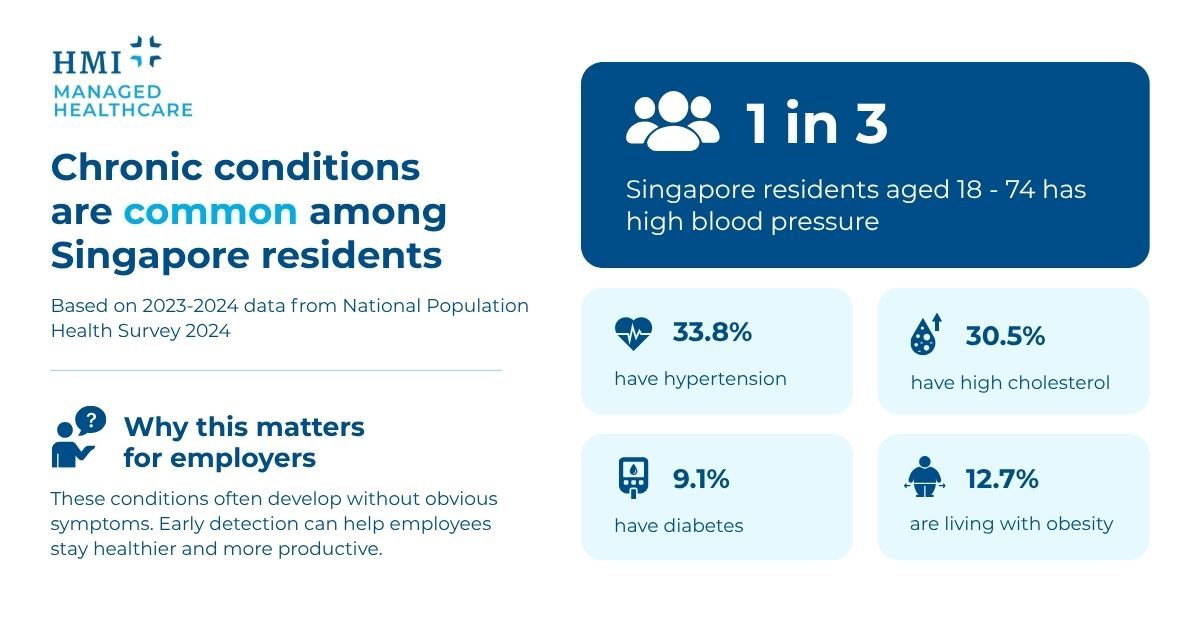
The Ministry of Health's National Population Health Survey shows that chronic conditions and their risk factors remain common among Singapore residents aged 18 to 74.
In 2023–2024:
- 33.8% had hypertension, or high blood pressure.
- 30.5% had hyperlipidaemia, or high cholesterol.
- 9.1% had diabetes.
- 12.7% were obese, based on a BMI of 30 kg/m² or above, compared with 10.5% in 2019–2020.
- 22.8% had a BMI of 27.5 kg/m² or above, a level associated with a higher risk of conditions including diabetes and cardiovascular disease.This includes people with a BMI of 30 kg/m² or above.
Screening remains an important part of early detection. In 2025, 71.5% of residents aged 40–74 without previously diagnosed diabetes, hypertension or high cholesterol were up to date with screening for all three conditions within the recommended intervals, up from 66.4% in 2024
There has been progress in some areas. High cholesterol prevalence fell from 39.1% in 2019–2020 to 30.5% in 2023–2024. Diabetes and hypertension remained broadly stable over the same period. Obesity, however, increased.
These are population statistics rather than workforce-specific figures. But they help show how common chronic health conditions are within the wider population from which Singapore's workforce is drawn.
Why does chronic disease need ongoing care?
A chronic disease is a health condition that persists over time. Depending on the condition, management may involve regular medical reviews, monitoring, medication, lifestyle changes or a combination of these.
Singapore's Chronic Disease Management Programme currently covers 23 conditions. These include diabetes and pre-diabetes, hypertension, lipid disorders, chronic kidney disease, stroke, ischaemic heart disease, asthma and chronic obstructive pulmonary disease, as well as several other physical and mental health conditions.
High blood pressure, high cholesterol and diabetes are particularly important because they can increase the risk of cardiovascular disease when they are not adequately managed.
Feeling well or seeing better health readings does not necessarily mean that treatment or monitoring can stop. Decisions about starting, changing or stopping treatment should be made with a healthcare professional based on the individual's condition, risk factors and response to treatment.
Cardiovascular disease accounted for about one-third of deaths in Singapore in 2024. MOH has also reported that an average of 36 people in Singapore experienced a heart attack each day in 2022, compared with 25 a day in 2012.
These conditions also account for a substantial proportion of primary care activity. In Singapore's polyclinics in 2025, high cholesterol accounted for 14.5% of all diagnoses, hypertensive disease 12.5% and diabetes 9.1%.
Screening can identify a risk. Follow-up helps manage it.
Health screening plays an important role in detecting chronic disease risk.
Someone can have high blood pressure, high cholesterol or elevated blood glucose without feeling unwell. Screening can help identify these changes before symptoms necessarily appear.
But a screening result is only one point in a person's health journey.
If a result is outside the recommended range, the next step may be to see a doctor for further assessment. Depending on the individual, this could lead to additional tests, regular monitoring, lifestyle recommendations, medication or referral for further care.
MOH specifically highlights both health screenings and follow-up as important parts of preventing or delaying chronic disease and its complications.
For employees, having a clear way to move from a screening result to appropriate follow-up can make that process easier to navigate.
What can employers do?
Employers are not responsible for diagnosing or treating chronic disease. Those decisions belong between employees and their healthcare professionals.
But the workplace can make it easier for people to look after their health.
The Health Promotion Board describes workplaces as an important setting for health promotion and includes chronic disease management and obesity prevention and management among its workplace health priorities.
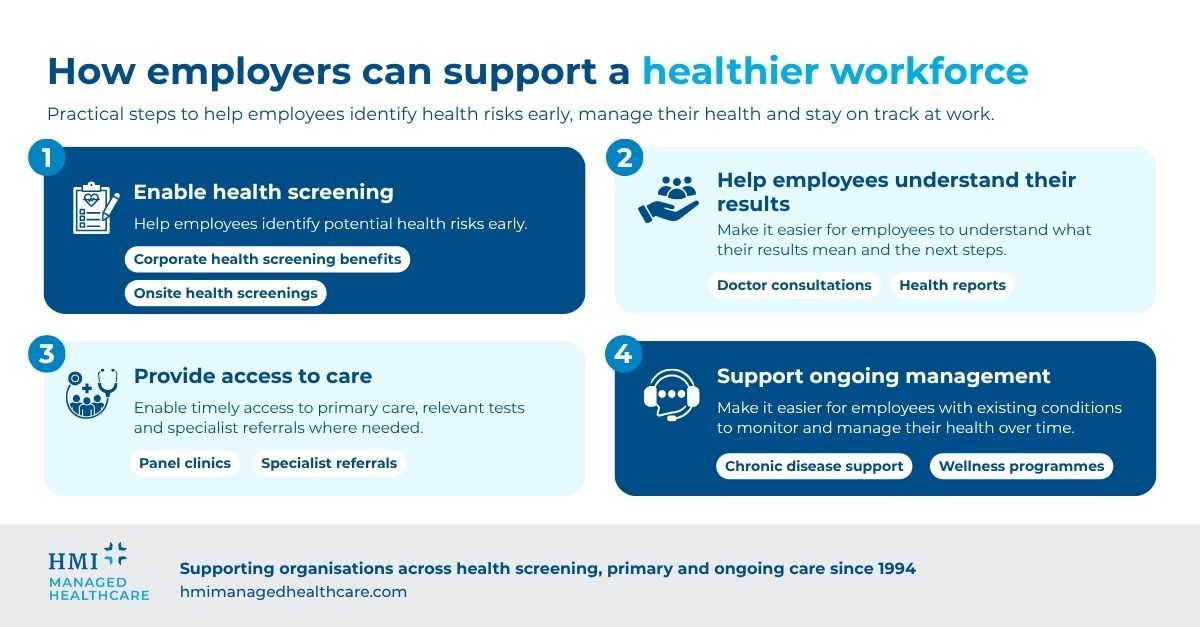
For employers, practical support may include making health screening accessible, providing clear pathways for follow-up, offering access to primary care and telemedicine, and ensuring employees understand the healthcare benefits available to them.
It can also mean looking at employee health as a continuum.
An employee who receives an abnormal screening result may need a medical review. Someone already living with diabetes or hypertension may need regular follow-up. Another employee may benefit from support with weight management, physical activity, nutrition or smoking cessation, depending on their individual health needs.
The aim is not more healthcare for its own sake. It is helping employees access appropriate care when they need it.
From screening to ongoing health management
A screening result is not the end of the process. For employees who need further care, what happens afterwards matters too.
Chronic disease management is different. It takes place over months and years.
For some employees, ongoing care may be as simple as monitoring a health indicator and making lifestyle changes. For others, it may involve regular GP consultations, medication reviews, blood tests or specialist care.
A more connected employee healthcare programme can help make those next steps clearer.
This can include a pathway from:
Screening → medical review → follow-up care → ongoing monitoring or treatment
That continuity matters because chronic disease management is rarely a single appointment or intervention.
How HMI Managed Healthcare supports employers
HMI Managed Healthcare works with organisations to manage employee healthcare and provide access to a range of corporate health services.
These include GP and specialist panel services, telemedicine, health screening, workplace health programmes and digital benefits administration.
HMI Managed Healthcare's corporate care services also include intervention programmes addressing chronic health risks such as hypertension and high cholesterol.
Telemedicine can also provide access to GP consultations and post-health-screening consultations, including appropriate referrals or medications where clinically indicated. It can complement in-person care where clinically appropriate, but does not replace face-to-face assessment when this is needed.
For employers, bringing these services together can help provide a clearer pathway from identifying a health risk to appropriate follow-up and longer-term care.
It can also help HR teams understand healthcare utilisation at an aggregate level while keeping individual clinical decisions where they belong: between employees and their healthcare professionals.
A useful question after every health screening
Health screening participation is an important measure.
But there is another question worth asking:
What happens when an employee's screening identifies something that needs attention?
For some, no further action may be needed. For others, that screening could be the start of ongoing care.
With hypertension, high cholesterol and diabetes remaining common among Singapore residents, chronic disease management is an important part of employee health.
Helping employees understand their results, take the appropriate next step and access ongoing care can help make existing health benefits more useful.
HMI Managed Healthcare supports organisations across screening, primary care and ongoing chronic disease management. Speak with our team to learn how these services can be integrated into your organisation's employee healthcare programme, or learn more about our Chronic Disease Management Programme.
References
- Ministry of Health, Singapore. “National Population Health Survey (NPHS) 2024 Report.” October 17, 2025. https://www.moh.gov.sg/others/resources-and-statistics/national-population-health-survey--nphs--2024-report/
- Ministry of Health, Singapore. “National Population Health Survey (NPHS) 2025 Report.” October 3, 2026. https://www.moh.gov.sg/others/resources-and-statistics/national-population-health-survey--nphs--2025-report/
- Ministry of Health, Singapore, “Chronic Disease Management Programme,” accessed September 30, 2026, https://www.moh.gov.sg/healthcare-schemes-subsidies/chronic-disease-management-programme
- Ministry of Health, Singapore, “Principal Causes of Death,” accessed September 30, 2026, https://www.moh.gov.sg/resources-statistics/singapore-health-facts/principal-causes-of-death
- Ministry of Health, Singapore. “Top 4 Conditions of Polyclinic Attendances.” September 30, 2026. https://www.moh.gov.sg/others/resources-and-statistics/top-4-conditions-of-polyclinic-attendances/